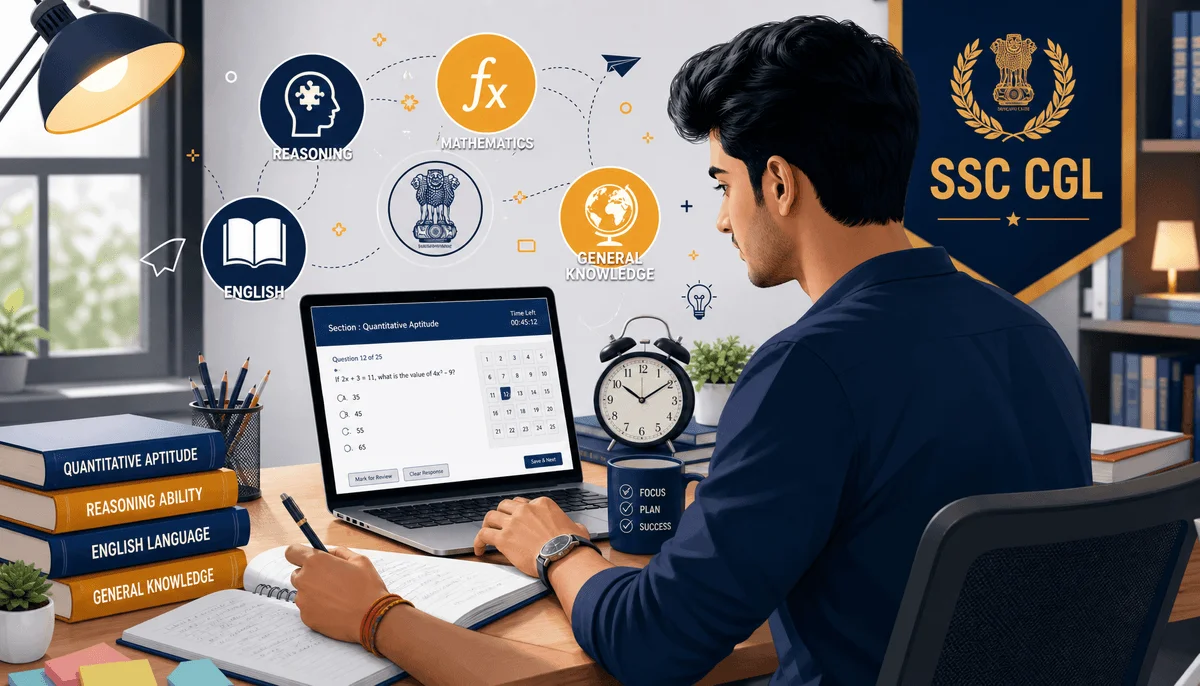
The SSC CGL (Combined Graduate Level) examination is one of the most sought-after government job exams in India, attracting lakhs of aspirants every year. Tier 1 is the qualifying gateway, and a smart, structured preparation strategy can make the difference between clearing the cut-off comfortably and falling short. This guide breaks down everything you need to crack Tier 1 with confidence.
Table of Contents
Understanding the Tier 1 Exam Pattern
Before diving into preparation, you must know exactly what you are up against. The SSC CGL Tier 1 is a computer-based objective test consisting of four sections, each carrying 50 marks for a total of 200 marks. You get 60 minutes to attempt 100 questions.
| Section | Questions | Marks |
|---|---|---|
| General Intelligence & Reasoning | 25 | 50 |
| General Awareness | 25 | 50 |
| Quantitative Aptitude | 25 | 50 |
| English Comprehension | 25 | 50 |
| Total | 100 | 200 |
There is a negative marking of 0.50 marks for every wrong answer, so accuracy matters as much as speed. Tier 1 is qualifying in nature for shortlisting, but a strong score builds momentum and confidence going into Tier 2.
Subject-Wise Preparation Strategy
General Intelligence and Reasoning
Reasoning is the most scoring section if practised well, because the questions are logic-based and require minimal memorisation. Focus on analogies, classification, series (number and alphabet), coding-decoding, blood relations, direction sense, syllogism, mirror and water images, paper folding, and non-verbal reasoning.

The key here is pattern recognition. Solve at least 30–40 reasoning questions daily and maintain an error log of question types you repeatedly get wrong. Aim to attempt this section quickly so you save time for the more time-consuming Quant.
General Awareness
This section is purely knowledge-based and the fastest to attempt during the exam, since there is no calculation involved. It covers History, Geography, Polity, Economics, General Science (Physics, Chemistry, Biology), Static GK, and Current Affairs of the last 6–8 months.

Build a habit of reading current affairs daily and revising static GK weekly. Science and Polity tend to carry significant weight, so prioritise them. A solid GA score can lift your overall percentile dramatically because the questions take only seconds to answer.
Quantitative Aptitude
Quant is often the deciding section and the most time-consuming. Core topics include number systems, percentages, ratio and proportion, average, time and work, time speed and distance, profit and loss, simple and compound interest, mensuration, geometry, trigonometry, algebra, and data interpretation.
Mastering shortcuts and Vedic maths techniques is essential to save time. Memorise tables up to 30, squares up to 30, cubes up to 20, and common fractions-to-percentage conversions. Practise calculation speed daily and treat geometry and trigonometry seriously, as they fetch easy marks once the formulas are internalised.
English Comprehension
English can be a high-scoring section for those with a reading habit. The syllabus covers reading comprehension, fill in the blanks, synonyms and antonyms, spelling correction, idioms and phrases, one-word substitution, sentence improvement, error spotting, and cloze tests.
Build vocabulary by learning 10–15 new words daily with usage. Focus heavily on grammar rules for error spotting and sentence improvement, since these are rule-based and predictable. Reading editorials from English newspapers improves comprehension speed and exposes you to new vocabulary in context.
A Practical Study Timetable
A balanced daily routine prevents burnout and ensures all four sections get attention. Here is a sample structure for serious aspirants:
- Morning (2 hours): Quantitative Aptitude — concept learning plus practice
- Midday (1.5 hours): Reasoning — practice sets and puzzles
- Afternoon (1 hour): English — grammar, vocabulary, comprehension
- Evening (1 hour): General Awareness — current affairs and static GK revision
- Night (1 hour): Revision of the day's learning and error log review
Adjust these blocks to fit your schedule, but maintain consistency. Three to four months of disciplined study is generally enough for a fresh aspirant, while working professionals may need five to six months at a steadier pace.
The Role of Mock Tests
No preparation is complete without regular mock tests. Mocks simulate real exam pressure, help you manage the 60-minute time limit, and reveal your weak areas. Start with one mock per week early in your preparation and increase to one every alternate day in the final month.
After every mock, spend more time on analysis than on the test itself. Identify which sections cost you time, which silly mistakes recur, and whether negative marking is hurting your score. This analysis-driven approach improves your score faster than simply solving more questions.
Smart Tips to Maximise Your Score
Time management inside the exam is critical. A widely used approach is to attempt General Awareness first (fastest), then English, then Reasoning, and finally Quantitative Aptitude. This ensures you bank easy marks before tackling the calculation-heavy section.
Avoid blind guessing because of the negative marking. Only attempt a question if you can confidently eliminate at least two options. Maintain accuracy above 90 percent in your attempts rather than chasing the maximum number of questions.
Revision is non-negotiable. Keep short formula sheets, GK notes, and vocabulary lists for quick daily revision. The last two weeks before the exam should be devoted almost entirely to revision and mock tests, not new topics.
Finally, take care of your health. Adequate sleep, short breaks, and light physical activity keep your mind sharp. Exam preparation is a marathon, not a sprint, and a calm, well-rested aspirant performs better than an exhausted one.
Final Words
Cracking SSC CGL Tier 1 is entirely achievable with a clear plan, consistent effort, and honest self-analysis. Understand the pattern, build subject-wise strength, test yourself regularly through mocks, and refine your strategy based on results. Stay disciplined, trust the process, and your selection will follow.